
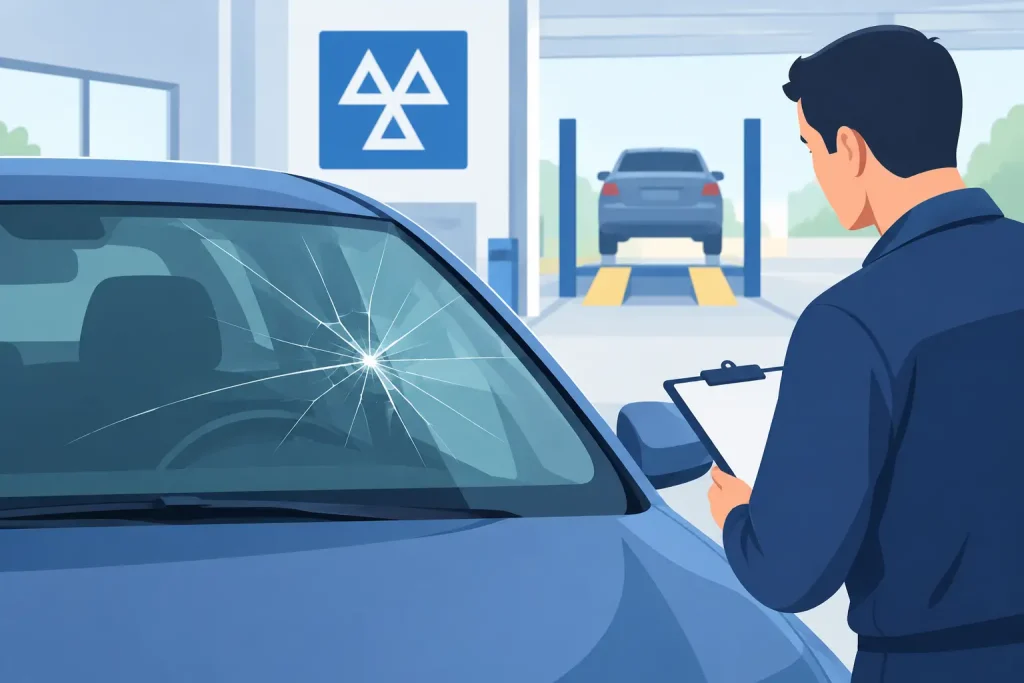
A crack can look minor when it first appears, then spread across the glass after a cold night, a pothole or a change in temperature. So, can cracked windscreens pass MOT? Sometimes, but only where the damage is outside the critical viewing area and remains within strict size limits. Waiting until test day is a gamble, particularly if the crack sits in your line of sight or has started to grow.
Can cracked windscreens pass MOT?
A cracked windscreen may pass an MOT if the damage is small enough and not in a location that affects the driver’s view. The test is concerned with whether the glass provides a clear, safe view of the road, not simply whether it has a visible mark on it.
For most vehicles in Great Britain, the key limits are based on the windscreen wipers’ swept area. Damage in the central area directly in front of the steering wheel must be no larger than 10mm. Damage elsewhere in the wipers’ swept area must be no larger than 40mm.
If a crack, chip or combination of damage exceeds these limits, the vehicle is likely to fail. A tester can also fail a vehicle where damage is judged to seriously obscure the driver’s view, even if measuring it is not straightforward. This is why an MOT pass should never be the only question. Clear vision and a sound windscreen matter every time you drive.
Where windscreen damage is measured
The most important part of the glass is known as Zone A. This is a 290mm-wide vertical strip in the windscreen directly in front of the steering wheel. It covers the area through which you need to see hazards, pedestrians, traffic lights and road markings without distraction.
A chip or crack larger than 10mm in Zone A is an MOT failure. Ten millimetres is a small measurement, so a crack can cross that threshold quickly. Do not assume that only a large star-shaped chip is a problem. A thin line across the glass still counts as damage and its full length may be relevant.
Outside Zone A, the remainder of the area swept by the windscreen wipers is also checked. Damage over 40mm here can lead to a failure. The unswept edges of the windscreen are less likely to be assessed against these particular size limits, but damage in those areas can still worsen, allow water into the vehicle or affect the integrity of the glass.
The exact position matters as much as the size. A small chip low down on the passenger side may be repairable and MOT-compliant. The same damage directly ahead of the driver may need attention much sooner.
Why a crack that seems harmless can still cause problems
Windscreen cracks rarely improve on their own. Road vibration, door slams, speed bumps and changes between heating and cold weather all put stress through the glass. A crack that is outside the driver’s view today can spread into the swept area before the MOT appointment.
Dirt and moisture can also enter the damaged section. This makes a high-quality repair harder because contamination can prevent the repair resin from bonding as effectively. If the crack reaches the edge of the windscreen, it is particularly likely to spread and may compromise the glass more quickly.
Modern windscreens do more than keep wind and rain out. In many vehicles, the windscreen contributes to the body structure and supports the passenger airbag during deployment. It may also hold cameras and sensors for driver-assistance systems such as lane support, automatic emergency braking and traffic-sign recognition. Damage, poor fitting or an unsuitable repair can affect more than visibility.
Repair or replacement: what is the right route?
A specialist will assess the type, size and position of the damage before recommending a repair or replacement. Small chips are often suitable for repair if they are dealt with promptly and are outside the critical viewing area. A successful repair can stop damage spreading and restore the strength of the affected section.
Cracks need closer assessment. Some short cracks may be repairable, depending on their location and condition, but longer cracks, edge cracks and damage in Zone A often make replacement the safer option. A repair may improve the appearance of the glass, but it will not always make a crack disappear completely. The key outcome is stable glass and an unobstructed view.
Replacement is usually recommended when the damage is too extensive, too close to the driver’s sightline or unsuitable for a dependable repair. It is also the sensible choice where the crack has spread from a previous chip, where there are several damaged areas, or where the inner layer of laminated glass has been affected.
If your vehicle has a forward-facing camera behind the rear-view mirror, replacement may require ADAS calibration after fitting. This checks that the camera is reading the road correctly again. It is a safety step, not an optional extra, and should be considered when arranging work on newer vehicles.
Do not leave the check until MOT day
An MOT tester can only assess the condition of the vehicle presented on the day. They cannot take account of when the crack first appeared or whether you have booked a repair for the following week. If the damage exceeds the limits, it can result in a failed test and leave you arranging another appointment after the work is completed.
Before booking your MOT, inspect the windscreen in daylight. Check for a chip or crack directly in front of the steering wheel, look across the full path of the wipers, and take note of any damage that reaches the edge of the glass. Run the wipers and washers too. Smears, worn blades and poor washer coverage can make a small defect much more distracting in wet conditions.
Avoid placing stickers, sat-nav mounts or parking permits over a damaged area. They may hide the problem temporarily, but they do not make it safe or MOT-compliant. Trying to seal a crack with tape can also trap moisture and dirt, reducing the chance of a clean repair.
What happens if the windscreen fails its MOT?
If the windscreen fails because of damage, arrange an inspection as soon as possible. A specialist can confirm whether repair is suitable or whether replacement is required, then explain any camera calibration needed for the vehicle. Once the glass has been repaired or replaced, the vehicle can be retested.
The practical impact depends on the fault recorded and the condition of the vehicle, but a failed MOT is not something to ignore. More importantly, a crack that obstructs your view can make driving in rain, glare or darkness harder than it needs to be. For commuters, delivery drivers and fleet vehicles, dealing with the glass promptly also helps avoid unwanted downtime.
A clear view is worth acting on early
The MOT limits provide a useful benchmark, but they are not a reason to keep driving with a spreading crack until it reaches the threshold. If you can see the damage from the driving seat, or you are unsure where it falls in relation to Zone A, have it checked before the test. Euro Windscreens can assess the glass and advise on the most appropriate route, helping you return to the road with clear vision and confidence.