
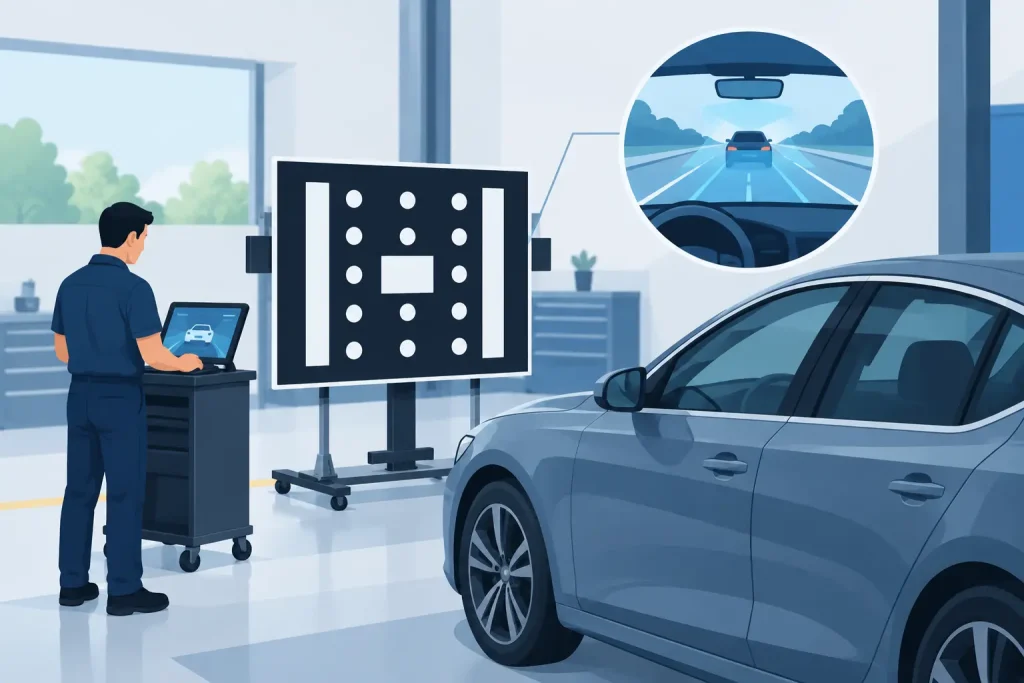
A windscreen replacement is no longer only about fitting clear glass. On many modern vehicles, the windscreen also supports a forward-facing camera that helps operate key driver-assistance features. ADAS recalibration after windscreen replacement checks that camera is reading the road from the correct position, so the systems designed to assist you can work as intended.
If your car has lane support, automatic emergency braking, traffic-sign recognition, adaptive cruise control or a forward collision warning, there is a good chance it relies on this camera. A correctly fitted windscreen and a correctly calibrated camera are both part of returning the vehicle to safe use.
Why a new windscreen can affect ADAS
The camera is commonly positioned behind the windscreen, close to the rear-view mirror. It looks through a precisely shaped and positioned area of glass. When the windscreen is removed and replaced, the camera may be disconnected, moved or refitted. Even a small change in its viewing angle can affect where the vehicle believes lane markings, other road users and road signs are located.
The replacement glass itself also matters. A vehicle that requires a camera-compatible windscreen needs the correct specification, including the relevant mounting bracket, shading and optical area. Fitting glass that is not suitable for the vehicle’s equipment can prevent the camera from operating correctly or make accurate calibration impossible.
This does not mean every windscreen replacement automatically requires the same work. Requirements vary by make, model, year and fitted technology. The reliable approach is to identify the vehicle specification before fitting the glass, then follow the required calibration procedure afterwards.
What ADAS recalibration after windscreen replacement does
Recalibration teaches or confirms the camera’s reference point after the glass has been changed. Diagnostic equipment communicates with the vehicle, while the technician follows the process set by the manufacturer. The aim is not simply to clear a dashboard warning. It is to make sure the camera can judge the road ahead from the right position.
There are two main methods. Some vehicles require static calibration, carried out in a controlled workshop setting. The vehicle is placed on a level surface and precisely positioned in relation to calibration targets. Measurements matter, including the vehicle’s height, wheel position and the distance to the targets.
Other vehicles use dynamic calibration. This requires a road drive under suitable conditions while the vehicle learns its surroundings. The route, road markings, traffic conditions and weather can all affect whether the procedure completes. Some manufacturers specify a combined process, with static work followed by a road test.
The right method depends on the vehicle, not on what is quickest. A specialist should use suitable diagnostic equipment, the correct targets where needed and a clear process for confirming that calibration has completed successfully.
Signs your vehicle may need calibration
A warning message after the replacement is the clearest sign, but it is not the only one. ADAS faults do not always present in an obvious way, and some systems may stay available while operating with reduced accuracy. That is why the vehicle specification should be checked rather than relying on a warning light alone.
You may also notice messages stating that camera visibility is limited or that lane assistance, emergency braking or traffic-sign recognition is unavailable. These can have other causes, such as dirt, heavy rain or a fogged windscreen, but they should not be ignored after glass work.
If an ADAS warning appears while driving, do not assume the feature will protect you. Continue to drive attentively, leave proper stopping distance and arrange an inspection as soon as practical. Driver-assistance systems support the driver; they do not replace the driver’s responsibility to observe the road.
Why calibration should not be skipped
A windscreen can look perfect and still leave a camera needing attention. This is the part of the job that is easy to overlook because it cannot always be seen from the driver’s seat. Yet the camera may be involved in safety systems that react to hazards in fractions of a second.
If its reference point is wrong, a system could identify a lane line, vehicle or road sign later, earlier or in the wrong place. The exact effect depends on the system and the degree of misalignment. A vehicle may also store fault codes, disable certain functions or display recurring warnings.
There is a practical point too. If a vehicle is used for commuting, deliveries, taxi work or a company fleet, unplanned downtime is costly. Checking the ADAS requirements during the replacement avoids handing back a vehicle with an unresolved warning or a safety feature that is not ready for use.
What to expect from the appointment
Before the work begins, the technician should establish the vehicle registration, model details and fitted equipment. This helps confirm the right windscreen and whether camera calibration is required. It is worth mentioning any warning lights, recent collision damage, suspension work or wheel alignment issues, as these can affect the wider diagnosis.
Once the new windscreen has been fitted, the bonding adhesive must have the correct safe drive-away time. This is set by the adhesive manufacturer and can vary with product, temperature and humidity. The vehicle should not be driven before it is safe to do so, even if a dynamic calibration is planned afterwards.
The calibration then takes place using the correct method for the vehicle. At the end, the technician should confirm the outcome and explain any fault that remains. If a camera will not calibrate, the cause may not be the replacement itself. Existing impact damage, a damaged camera, incorrect wheel alignment, a weak battery, diagnostic faults or an unsuitable screen can all need further investigation.
Static and dynamic calibration: the practical difference
Static calibration is generally more controlled. It can be completed without relying on suitable road conditions, but it needs the right workshop space, accurate measurements and correctly positioned targets. This makes preparation essential.
Dynamic calibration can be efficient where the manufacturer permits it, but it depends on a suitable drive. Poor weather, faded lane markings, congestion or unsuitable roads may delay completion. A short drive around the block is not always enough. The system must meet its own conditions before it accepts the calibration.
Neither method is inherently better. The correct one is the procedure specified for your vehicle. A proper job follows that requirement rather than choosing a method based solely on convenience.
Questions worth asking before the work
When booking a replacement, ask whether your vehicle has a windscreen-mounted camera and whether ADAS recalibration is included or required. Provide the registration and mention any assistance features you know the vehicle has. If you are unsure, a specialist can check the specification.
It is also sensible to ask how long the full appointment may take. A straightforward replacement can become longer where adhesive curing and a calibration procedure are needed. Planning for that time is better than finding out late in the day that the car cannot be collected immediately.
For fleet operators, it helps to record the replacement and calibration result against the vehicle. That gives a clear service history and helps identify whether a later dashboard warning is new or already present before the glass work.
Choosing the right replacement service
The quality of the glass, fitting and calibration process should be considered together. A low price can be false economy if it excludes the diagnostic work a modern vehicle needs. Equally, not every vehicle with a camera requires the same procedure, so a clear assessment is more useful than a one-size-fits-all answer.
Euro Windscreens can assess the glass and ADAS requirements before work starts, fit the appropriate windscreen and carry out the necessary checks. The goal is straightforward: restore clear vision, secure weather protection and the safety systems your vehicle relies on.
After collection, keep the camera area clean and avoid attaching stickers, mounts or accessories in its field of view. If an ADAS warning appears, or a feature seems unavailable, arrange a check rather than waiting for it to resolve itself. A replacement windscreen should leave you ready to use the road with confidence, not with a question mark on the dashboard.